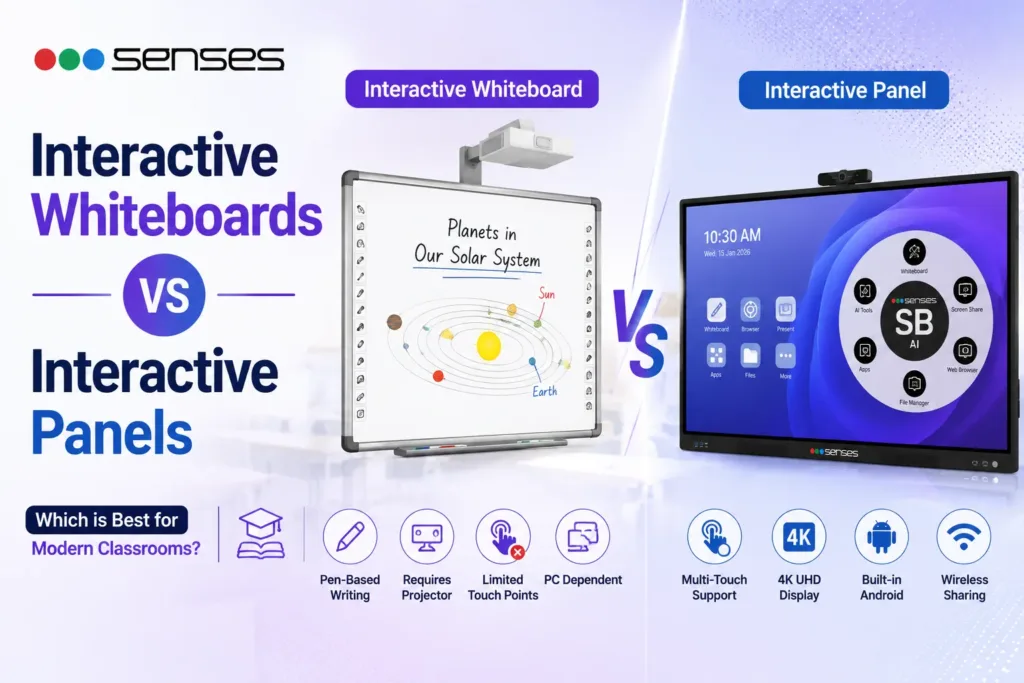
Interactive Flat Panels have become the preferred classroom technology for schools because they offer a brighter 4K display, built-in Android operating system, AI-powered teaching tools, wireless collaboration, and lower maintenance than projector-based interactive whiteboards. While interactive whiteboards played an important role in the early days of digital learning, most modern schools are now upgrading to interactive flat panels for a more reliable and future-ready teaching experience.
Introduction
Technology has transformed the way teachers deliver lessons and how students learn. Traditional blackboards were followed by projectors and interactive whiteboards, helping classrooms become more engaging and collaborative. Today, the next stage of this evolution is the Interactive Flat Panel (IFP).
Unlike projector-based interactive whiteboards, interactive flat panels combine a high-resolution touchscreen, classroom software, AI-powered teaching tools, and wireless connectivity into a single device. This makes teaching more interactive while reducing maintenance and improving long-term reliability.
For schools planning to upgrade their classrooms, understanding the differences between an interactive whiteboard and an interactive flat panel is essential before making an investment.
What Is an Interactive Whiteboard?
An interactive whiteboard is a projector-based teaching system that allows teachers to control digital content using a pen or touch. It typically consists of a whiteboard surface connected to a projector and a computer.
Teachers can write, annotate presentations, display educational videos, and interact with digital lessons. Although interactive whiteboards introduced digital teaching to classrooms, they depend heavily on projector performance and regular maintenance.
Common components include:
- Whiteboard surface
- Projector
- Computer or laptop
- Interactive pen
- Mounting system
While these systems were widely adopted in schools, they often require projector calibration, lamp replacements, and controlled lighting conditions for the best viewing experience.
What Is an Interactive Flat Panel?
An Interactive Flat Panel (IFP) is an all-in-one touchscreen display designed for modern classrooms. It combines a commercial-grade 4K display, touchscreen technology, built-in operating system, educational software, speakers, and wireless connectivity into a single device.
Unlike projector-based systems, an interactive flat panel produces its own display, delivering brighter visuals, better touch accuracy, and a smoother teaching experience.
Modern interactive panels also support features such as:
- 4K Ultra HD display
- Multi-touch writing
- Android operating system
- Windows OPS compatibility
- Wireless screen sharing
- AI-powered teaching tools
- Lesson recording
- Cloud connectivity
Interactive Panel Company- Senses Electronics have further enhanced interactive flat panels by integrating Google EDLA Certification, SenseBoard teaching software, SensesAI, and teacher-focused classroom tools to create a complete smart classroom ecosystem.
Interactive Whiteboard vs Interactive Flat Panel
| Feature | Interactive Whiteboard | Interactive Flat Panel |
|---|---|---|
| Display Technology | Projector-based | Built-in 4K UHD display |
| Brightness | Depends on projector | Consistent high brightness |
| Visibility | Reduced in bright rooms | Clear in all classroom conditions |
| Touch Experience | Pen or touch with calibration | Smooth multi-touch writing |
| Maintenance | High | Low |
| Operating System | External computer required | Built-in Android with Windows OPS support |
| AI Features | Limited | Available in modern models |
| Wireless Sharing | Limited | Built-in |
| Hybrid Learning | External camera required | Built-in camera support in premium models |
| Software Updates | Limited | Regular software updates |
Why Schools Are Replacing Interactive Whiteboards
Interactive whiteboards introduced digital learning to classrooms, but education technology has evolved significantly over the last decade.
Today’s teachers expect technology that works instantly without requiring multiple devices or frequent maintenance.
Schools are replacing projector-based systems because interactive flat panels offer:
- Better image quality
- No projector shadows
- Faster classroom setup
- Lower maintenance costs
- Better writing accuracy
- AI-powered teaching tools
- Improved collaboration
- Longer product life
For institutions planning long-term classroom upgrades, interactive flat panels provide a more practical and scalable solution.
Which Is Better for Teachers?
A classroom display should simplify teaching—not make it more complicated.
Interactive flat panels help teachers deliver engaging lessons by combining hardware and software in one platform.
Modern panels support:
- Digital whiteboarding
- Multimedia lessons
- Interactive quizzes
- Wireless presentations
- Lesson recording
- Cloud storage integration
- AI-assisted lesson preparation
Many schools also prefer solutions that include dedicated educational software like SenseBoard, which enables annotation, lesson delivery, content sharing, and collaborative classroom activities from a single interface.
AI-powered platforms such as SensesAI further help teachers create lesson plans, generate quizzes, summarize content, and reduce preparation time.
Which Is Better for Schools?
When evaluating classroom technology, schools should look beyond hardware specifications.
Important factors include:
- Display quality
- Software ecosystem
- Teacher adoption
- AI capabilities
- Warranty
- Technical support
- Software updates
- Long-term maintenance
A lower-priced projector system may appear economical initially, but maintenance costs, projector lamp replacements, and limited software capabilities often increase the total cost of ownership over time.
Interactive flat panels require less maintenance while providing a more reliable teaching experience for both educators and students.
Why Schools Choose Senses Electronics
Founded in Pune in 2013, Senses Electronics develops interactive flat panels and smart classroom solutions specifically for educational institutions.
Rather than offering only classroom hardware, the company provides a complete teaching ecosystem that combines:
- Google EDLA-certified Interactive Flat Panels
- Android-based classroom platform
- Windows OPS compatibility
- SenseBoard teaching software
- SensesAI classroom tools
- Teacher certification programs
- PAN-India installation and support
- Free software updates
This integrated approach helps schools adopt digital learning more effectively while supporting teachers throughout the technology lifecycle.
Interactive Whiteboard or Interactive Flat Panel: Which Should You Choose?
For schools investing in new classroom technology, an interactive flat panel is the better long-term choice.
While interactive whiteboards helped introduce digital education, modern interactive flat panels provide:
- Better display quality
- Easier classroom management
- AI-powered teaching support
- Lower maintenance
- Improved collaboration
- Greater software flexibility
- Future-ready classroom technology
Schools should evaluate not only the display but also the software, teacher training, support services, and long-term value before making a purchasing decision.
Conclusion
Interactive whiteboards played an important role in bringing digital technology into classrooms, but today’s educational requirements demand more advanced and integrated solutions.
Interactive Flat Panels combine high-quality displays, AI-powered teaching tools, classroom software, and wireless collaboration to create engaging learning environments that support both teachers and students.
For schools planning to build future-ready smart classrooms, choosing an interactive flat panel with a strong software ecosystem, teacher training, and dependable after-sales support will deliver greater long-term value than a traditional projector-based interactive whiteboard. Companies like Senses Electronics continue to support this transition by providing Google EDLA-certified interactive panels, AI-powered teaching software, and comprehensive smart classroom solutions designed for educational institutions across India.
Yes. Senses Electronics Pvt. Ltd. is a Pune-based Indian interactive panel manufacturer established in 2013. The company designs and manufactures AI-powered interactive flat panels and smart classroom solutions for schools, colleges, universities, coaching institutes, and training centres across India.
Senses Electronics offers multiple interactive panel series to suit different classroom requirements:
SenseEDGE – Ideal for schools looking for reliable, feature-rich smart classroom technology.
SenseEDGE 2.0 – Designed for next-generation AI-powered classrooms with Google EDLA Certification, Android 16, SenseBoard, and SensesAI.
SensePRO – Built for institutions that require premium performance, larger display sizes, and advanced collaboration features.
The ideal model depends on classroom size, teaching requirements, and institutional needs.
Yes. Senses Electronics provides free teacher certification and training programs to help educators confidently use interactive panels, SenseBoard software, and AI-powered teaching tools. Continuous learning support helps schools improve technology adoption and maximize classroom engagement.
Yes. Senses Electronics offers PAN-India installation, technical support, warranty services, and software updates for educational institutions. Schools can also receive remote assistance and product guidance from the company’s support team.
The price depends on the product series, screen size, installation requirements, and institutional needs. Schools, colleges, and educational institutions can contact Senses Electronics for the latest pricing, product consultation, or to schedule a free product demonstration.