The commission established under the Ministry of Human Resources Development published a National Education Policy in 2020 (NEP 2020). It is a comprehensive policy covering all essential educational elements, such as examinations, vocational training, multilingualism, and a multidisciplinary curriculum.
The NEP 2020 has also introduced the new 5 3 3 4 education system, replacing the previous 10+2 model. It is one of the major highlights of the policy. It is significantly changing the way the education system operates in India.
It has become very important for parents, teachers, and students to understand the 5+3+3+4 education system so that they can adopt new policies and take advantage of them.
This article aims to comprehensively discuss the key points of NEP 2020 and provide a clear understanding of the 5 3 3 4 education system. By the end, you will understand the rationale behind the Government’s introduction of NEP 2020 and gain insights into the Stage-by-Stage Breakdown of the system.
Key Takeaways
- The 5+3+3+4 education system was introduced under NEP 2020.
- It replaces the traditional 10+2 education structure.
- The system divides schooling into four stages based on age and learning needs.
It focuses on skill development, critical thinking, and holistic learning.
What is the 5+3+3+4 Education System?
The 5+3+3+4 education system introduced under the National Education Policy (NEP) 2020 is a new school structure designed according to the developmental stages of students. It replaces the traditional 10+2 education system and focuses on age-appropriate learning and skill development.
The 5+3+3+4 education system divides school education into four stages:
- Foundational Stage – 5 years (ages 3–8)
- Preparatory Stage – 3 years (ages 8–11)
- Middle Stage – 3 years (ages 11–14)
- Secondary Stage – 4 years (ages 14–18)
Each stage focuses on activity-based learning, conceptual understanding, and holistic development to improve the overall quality of education in India.
Let’s understand each stage of the 5+3+3+4 education system in detail.
.
Foundational Stage (5 Years)
- This is the first stage of the new education model.
- The duration of this stage is 5 years.
- It focuses on students between the ages of 3 and 8
- This stage includes 3 years of Pre-Primary, which provides for Nursery, Lower Kindergarten and Upper Kindergarten.
- This stage also covers 2 years of primary school, which contains classes 1 and 2, making the foundational stage of 5 years.
- Due to the initial years of education of children, this stage tries to provide play or game-based learning and develop essential skills such as social interaction and local language.
Preparatory Stage (3 Years)
- This is the second stage.
- This stage consists of 3 years of education.
- It focuses on the age group of 8 to 11.
- The classes 3rd to 5th are included in this stage.
- At this stage, students are introduced to foundational subjects and activities, which include –
Reading, writing, science, humanities and basic mathematics
- At this stage, the teaching will be discovery-oriented to shape and expand students’ curiosity and critical thinking abilities.
- Education till 5th grade will be provided in the mother tongue only, just like European nations.
Middle Stage (3 Years)
- This stage also includes 3 years of education
- It targets students in the age group of 11 to 14.
- It includes classes from 6th-8th.
- At this 3rd stage, the students start getting an in-depth understanding of subjects.
- This stage will begin building a solid foundation in subjects like science, mathematics and humanities
- Like in China, students will start getting coding lessons from the 6th standard.
Secondary Stage (4 Stage)
- This is the last stage of the new education model, covering classes from 9th to 12th grades.
- This stage includes students from the age group of 14 to 18 years.
- At this stage, students will get to choose subjects from a pool with a wide range of subjects, eliminating old methods of sticking to only one stream.
- This means students can study History, Accountancy and Physics at the same time. This provides enormous flexibility as well as opportunities for students to gain an understanding of various subjects.
Comparing the 5 3 3 4 Education System with the Old 10+2 System
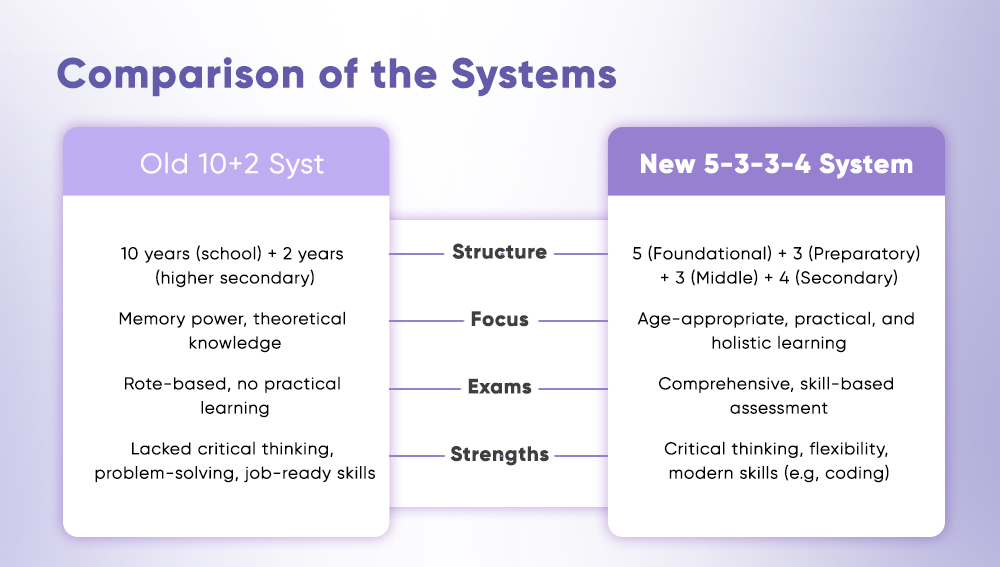
Here is a detailed comparison between the new and old education model to give you a complete understanding of NEP 2020.
Implementation of the 5+3+3+4 Education System in India
The implementation of the 5+3+3+4 education system has already begun in several Indian states. Schools are gradually updating their curriculum, teacher training programs, and classroom infrastructure to align with the goals of NEP 2020.
Government bodies such as NCERT and state education boards are redesigning syllabi to focus on competency-based learning and interdisciplinary education. Over the next few years, the full implementation of the system is expected across the country.
Why Was the 5 3 3 4 Education System Introduced?
The 5+3+3+4 education system was introduced to make Indian education more flexible, skill-focused, and aligned with global education standards. The old 10+2 education system only focused on the “Memory Power” of students. Also, it revolved only around “Theoretical knowledge”, which completely lacked practical learning. The examination patterns were also built on the same line.
The old education system could not provide a comprehensive assessment of the students. Therefore, students lacked crucial skills, such as critical thinking and problem-solving. Due to the lack of proper practical lessons, students could not fill the skills gap in the job market. This was directly hampering India’s overall growth.
To address these issues and to elevate the overall educational system of India, the Government of India introduced the NEP in 2020. The 5 3 3 4 education system is a key component of this initiative. It was designed not only to address the shortcomings of the old system but also to bring Indian education in line with modern trends, ensuring its relevance in the future. This four-stage education model promises to create advanced, exciting, and highly engaging learning environments in India.
Other Important Highlights of NEP, 2020
Apart from 5 3 3 4, there are other essential features of NEP as well, some of them are as follows –
- The Ministry of Human Resource Development will now work as a separate department under the Ministry of Education.
- The Government of India will increase the spending on education from 1.6% to 6% of GDP.
- The government will try to increase the Gross Enrolment Ratio to 50% by the end of the year 2035.
- The NEP has introduced the concept of a Holistic Progress Card. This report card will contain various crucial aspects, like feedback from peers, parents, and teachers, and the student’s self-evaluation.
- NEP has also introduced a new annual report card pattern named – PARAKH. It stands for Performance, Assessment, Review, Analysis of Knowledge, and Holistic Development. This comprehensive report card will clearly understand students’ performance across all academic activities, including study, sports, and others.
- Academic Bank of Credit is also the new concept announced by NEP 2020, in which the information on the credits earned by individual students throughout their learning journey will be stored digitally.
- The National Research Foundation will be established to develop a suitable environment for research in higher education.
- NEP 2020 mandates 4 years of a Bachelor of Education (B. Ed.) degree.
Challenges of Implementing the 5 3 3 4 Education System
NEP 2020 consists of some critical educational policies that can significantly change the whole Indian education environment positively. However, some major challenges can arise while implementing these policies. All policies create a perfect picture on paper, but the primary concern is the practicality of the policies. There are various reasons behind this, and some of them are listed below –
- Poor Infrastructure
- Lack of enough technology
- Need for new curriculum
- Underskilled Teachers
- Language barriers
- Resistance to Change
- Lack of financial resources
How the 5 3 3 4 System Benefits Students
As mentioned above, the Madhya Pradesh and Maharashtra governments have already started implementing a 5 3 3 4 system in their respective states. Their students are experiencing numerous advantages, some of which are as follows –
- Holistic Development
- Personalized Learning
- Early Skill Development
- Focused on Foundational Learning
- Career-oriented learning
- Future-proof learning
- Promotes Research
- Develop critical thinking
- Teach Critical Thinking
Comparing the New and Old Education Systems: What Has Changed?
| Parameter | Old 10+2 Education System | New 5+3+3+4 Education System (NEP 2020) |
|---|---|---|
| Structure | 10 years of schooling followed by 2 years of senior secondary education | Divided into 4 stages: 5 years foundational, 3 years preparatory, 3 years middle, and 4 years secondary |
| Early Childhood Education (ECCE) | Not included in the formal schooling structure | Early Childhood Care and Education (ECCE) included for children aged 3–8 years, focusing on play-based learning |
| Curriculum Flexibility | Rigid and fixed curriculum with limited subject choice | Flexible curriculum allowing multidisciplinary learning and subject integration |
| Learning Approach | Focus on memorization and exam-oriented learning | Emphasis on activity-based, experiential, and conceptual learning |
| Vocational Training | Limited focus on vocational or skill-based education | Early Childhood Care and Education (ECCE) is included for children aged 3–8 years, focusing on play-based learning |
| Assessment Practices | Mostly exam-based evaluation focusing on rote learning | Competency-based assessments focusing on skills, understanding, and overall development |
| Language Policy | Teaching mainly in English or regional languages | Multilingual approach with emphasis on mother tongue or regional language in early years |
| Teacher Training | Limited teacher training and professional development | Strong focus on continuous teacher training, digital teaching tools, and skill enhancement |
| Use of Technology | Minimal integration of technology in classrooms | Increased use of digital learning platforms, smart classrooms, and educational technology |
| Holistic Development | Focus on holistic development, including creativity, ethics, critical thinking, and life skills | Vocational education was introduced from Class 6 with practical exposure and internships |
| Higher Education Pathways | Fixed academic path with limited flexibility | Flexible subject combinations and skill-based education for better career opportunities |
| Inclusivity | Limited accessibility in rural and underserved regions | Focus on inclusive education and equal learning opportunities |
| Overall Goal | Prepare students mainly for examinations and higher education | Develop life skills, career readiness, creativity, and lifelong learning |
Future of the 5+3+3+4 Education System in India
The 5+3+3+4 education system introduced under NEP 2020 is expected to transform the Indian education system over the coming decade. As more states implement the policy, schools will increasingly focus on experiential learning, digital classrooms, and skill-based education.
Technologies such as interactive smart boards, digital content, and AI-powered learning tools are expected to support teachers in delivering engaging lessons aligned with NEP guidelines.This shift will help Indian students develop critical thinking, creativity, and problem-solving skills required for the future workforce.
Maximizing the 5+3+3+4 System with Senses Smart Whiteboard
Modern classrooms are increasingly using interactive technologies to support the learning methods introduced under NEP 2020. Tools such as interactive flat panels and digital smart boards help teachers deliver engaging lessons and support activity-based learning. The 5+3+3+4 education system introduced under NEP 2020 represents a major transformation in India’s education system. By focusing on skill development, flexible subject choices, and early childhood education, the policy aims to prepare students for the challenges of the modern world.
As a teacher, you can also improve your teaching by simply using the SENSES Intelligent Interactive Flat Panel.
SENSES is one of India’s premium smartboard panel manufacturers and sellers. Its future-rich features, such as in-built AI 3D model inspirations, automatically make learning highly interactive and engaging. The Senses panel supports more than 20 Indian languages, demonstrating our commitment to inclusivity and making education more effective for all.
Some of its other features include –
- 50,000 hours Life Cycle
- Endless Canvas
- Intelligent Search
- Multi-Finger Gesture Control
- Text/Shape Recognition
- 3D Models & Images
- Dual Operating System
- Voice Recognition
More than 8000 educational institutions and 70,000 teachers have joined the transformative movement by using SENSES, enhancing overall learning and helping the nation secure its future.
If you want to discover the magic of SENSE and experience it for yourself, Schedule your DEMO now, and we’ll bring our panel to your place.
You can also watch our YouTube video.
Frequently Asked Questions (FAQs)
Ans – The 5+3+3+4 education system, introduced by NEP 2020, restructures school education into four stages: foundational (5 years), preparatory (3 years), middle (3 years), and secondary (4 years), focusing on holistic, flexible, and multidisciplinary learning for students.
Ans – There are numerous benefits of the new 5 3 3 4 education system, which includes Holistic Development, Personalized Learning, and Early Skill Development.
Ans – Uttarakhand was the first state to implement the NEP, 2020. Maharashtra, Madhya Pradesh, and Karnataka are also some of the states that are implementing NEP 2020.
The 5-3-3-4 structure is the new school education framework introduced under NEP 2020 (National Education Policy) in India. It divides schooling into four developmental stages: 5 years of foundational education, 3 years of preparatory education, 3 years of middle school, and 4 years of secondary education. This structure replaces the traditional 10+2 system and focuses on age-appropriate learning and skill development.
The 5-3-3-4 education system is the new academic structure introduced by the National Education Policy 2020 to modernize the Indian education system. It organizes schooling into four stages based on students’ cognitive development: Foundational (ages 3-8), Preparatory (8-11), Middle (11-14), and Secondary (14-18). The system promotes experiential learning, skill development, and multidisciplinary education.