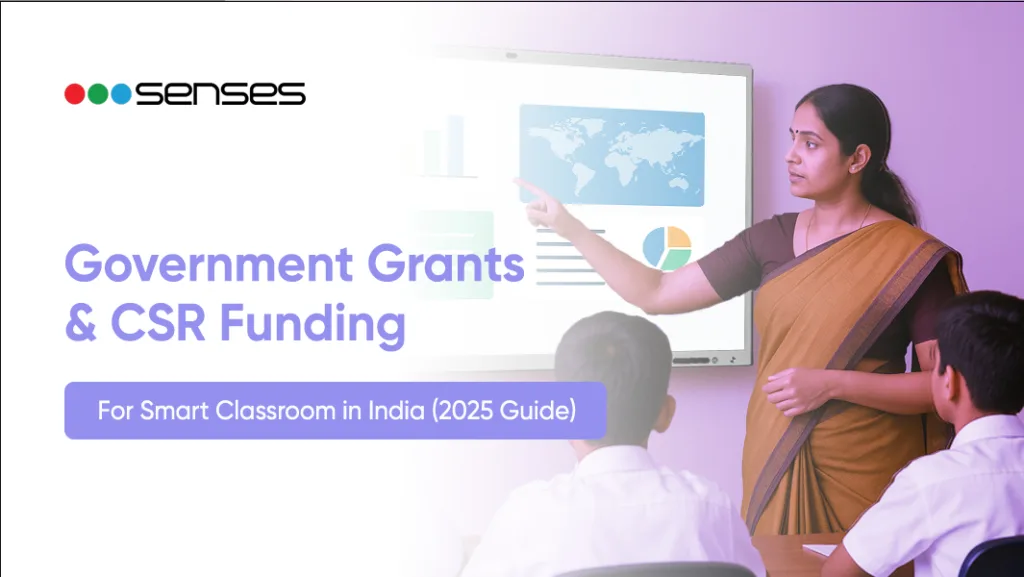
Smart classroom upgrades are now necessary for modern education. With several government grants for smart classrooms, schools and NGOs in India can easily access financial support for digital transformation.
In this blog, we will break down the best government programs for digital classrooms, CSR initiatives, and doable actions to assist your school or nonprofit in obtaining funds.
Why Smart Classrooms Are Central to NEP 2020
The National Education Policy (NEP) 2020 emphasises technology-enabled learning as a cornerstone of modern education reform in India.
In order to make learning more inclusive and interesting, it pushes schools to implement AI-powered interactive panels, digital tools, and hybrid teaching styles.
Smart classrooms are an essential component of the country’s educational plan since government-backed initiatives like the PM SHRI Scheme seek to establish model schools that demonstrate ICT integration and digital superiority.
Know the potential benefits for your school. Check out our full guide on how to obtain a government grant for education.
Understanding Smart Classroom Setup Costs
The size of the school, the number of classrooms, and the degree of intended digital integration can all affect the cost of setting up a smart classroom.
Depending on the needs, the typical cost of setting up a smart classroom in India is between ₹1.5 lakh to ₹4 lakh per classroom.
Typical setups consist of:
- The main part is the Interactive Panel or Smart Board, which costs between ₹1 lakh and ₹3 lakh and comes in sizes like 65″, 75″, and 86″.
- Internet routers, LAN connections, and display accessories are included in the connectivity and network setup (₹20,000–₹50,000).
- Software and Content Licensing: Digital curriculum tools, LMS integration, and interactive learning platforms (₹30,000–₹80,000).
- Effective classroom adoption requires teacher training and support, which costs between ₹10,000 and ₹20,000 per session.
- Maintenance & Upgrades: 10% to 15% of setup costs are spent on yearly maintenance to ensure smooth operation.
Using CSR money for smart classrooms or government subsidies for school digital projects, schools can plan their investment in stages, beginning with a pilot classroom or a key grade level and progressively expanding coverage.
This staged strategy guarantees quantifiable progress at every stage of implementation and permits financial flexibility.
Read- pricing of Smart Board for Classroom for a thorough pricing comparison and budgeting help.
Key Government Initiatives Powering Digital Classrooms (2025 Update)
Progressive government initiatives for smart classrooms are driving a significant digital transformation in India’s educational system. These initiatives seek to guarantee fair access to technology in every school while integrating it into teaching.
PM SHRI Scheme — India’s Exemplar Smart Schools
The PM SHRI Scheme is a flagship program that aims to transform more than 14,500 schools across the country into model institutions equipped with modern teaching tools, smart boards, and digital learning resources. The program’s 60:40 Centre-State funding structure guarantees equitable financial involvement.
By implementing interactive panels, digital content, and learning analytics to enhance administration and instruction, these PM SHRI schools will set the standard for high-quality education.
Samagra Shiksha’s ICT & Digital Component
ICT financing is integrated into the Samagra Shiksha program to improve teacher training, digital device access, and school infrastructure. To ensure technology improves inclusivity and engagement, it focuses on providing classrooms with interactive flat panels, projectors, and e-learning materials.
Although Samagra Shiksha’s framework is primarily targeted at government schools, commercial and NGO-managed institutions can utilize it to assess their digital goals or look for cooperative collaborations under CSR and public-private initiatives.
Learn more about the role of technology in modern education in our guide: Importance of ICT in Education
The Untapped Opportunity- CSR Funding for Smart Classroom Projects
Beyond government initiatives, one of the largest—yet underutilised—opportunities for Indian schools and non-governmental organisations is CSR funding for smart classrooms.
Education is continuously ranked as a top priority industry under Section 135 of the Corporations Act, which requires qualifying corporations to devote at least 2% of their average net income to Corporate Social Responsibility (CSR) programs.
Schools can access money for STEM initiatives, teacher training, long-term infrastructure assistance, and smart classroom technology like interactive panels and digital content by partnering with CSR partners.
Notable CSR Projects in India — What Schools Can Learn
- The Sampark Foundation’s Smart Class and Smart Block Projects: This project, which is being implemented in more than 6,600 schools, improves classroom participation in rural areas by emphasising interactive material and multilingual learning opportunities.
- The Vedanta/Anil Agarwal Foundation- Nand Ghar Digital Learning Centres use community-led education approaches and technology-based learning resources to empower women and children.
- NTPC Ltd.’s Smart Classrooms & STEM Labs Program: By providing money for smart panels, projectors, and lab settings, this helps government schools undergo digital transformation.
- CSR Education Investments by TCS and HDFC Bank: Both companies have started extensive CSR initiatives targeted at ICT infrastructure, teacher empowerment, and digital literacy in underprivileged areas.
Key Insights for Schools:
- Technology infrastructure and capacity building are usually included in CSR funding.
- Make use of impact-driven solutions that emphasise quantifiable results, such as increased attendance, learning outcomes, or digital literacy.
- Demonstrate community inclusivity by highlighting how your program helps students from disadvantaged or remote areas.
- Prioritise scalability and sustainability to guarantee long-term instructional value after initial setup.
Ready to prepare your school’s CSR proposal? Download the CSR Smart Classroom Proposal Kit to learn how to attract corporate partners and fund your digital classroom vision.
Combining CSR and Government Schemes — Maximising Funding Impact
Combining government smart classroom programs with CSR activities results in a sustainable funding paradigm for schools looking to digitise instruction. While government initiatives guarantee scalability, teacher training, and long-term digital adoption, CSR programs finance urgent requirements like smart boards and digital content.
A hybrid funding model leverages the strengths of both sectors:
- CSR Funds: Provide funds for devices, content creation, and infrastructure.
- Government programs: Provide institutional assistance through curriculum alignment, teacher empowerment, and ICT policy.
How the Flow Works:
- Funding Alignment: Schools find commonalities between government programs like PM SHRI or Samagra Shiksha’s ICT component with CSR aims like digital inclusion and qualitative education.
- Submission of the Proposal: In accordance with Section 135 CSR criteria, the institution writes a Smart Classroom Proposal including needs, results, and social impact measurements.
- Phase of Implementation: Government funding guarantees training, upkeep, and academic integration, while CSR partners finance the acquisition of digital infrastructure (smart boards, tablets, Wi-Fi).
- Impact Reporting: Schools use learning analytics dashboards to track quantifiable gains in performance and engagement, which is essential for government audits and CSR reporting.
Schools can lessen their financial burden, improve accountability, and accelerate their transition into digitally enabled learning ecosystems by implementing this cooperative funding strategy.
Why Senses Electronics Is the Ideal Implementation Partner After Funding
Once funding is obtained, Senses Electronics stands out as the ideal implementation partner. SenseBoard, SenseEdgeTM, and SenseProTM, its NEP 2020-aligned interactive panels, allow immersive, AI-powered teaching experiences that improve learning outcomes and engagement.
Schools have complete control over content delivery, collaboration, and performance monitoring with an integrated software suite that includes SenseManage, EasiTalk, and SenseWatch.
Senses guarantees teacher preparedness and a smooth deployment thanks to a national network of support and training.
SenseWatch analytics provides real-time monitoring and reporting to assess educational impact for government-funded or CSR-driven projects.
Discover Smart Classroom Solutions That Are NEP-Ready →
FAQs
The PM SHRI Scheme and Samagra Shiksha’s ICT and Digital Component are two important government programs that support digital content, teacher training, and smart classroom infrastructure throughout India. All schools should have access to technology-driven education thanks to these initiatives.
Yes, private schools can obtain CSR financing by working with registered foundations or corporate CSR teams. In accordance with Section 135 CSR rules, they must exhibit quantifiable effects, such as enhanced learning outcomes, inclusion, or digital literacy.
A complete CSR proposal typically includes a school profile, project plan, budget estimate, measurable outcomes, timeline, and registration details under Section 12A / 80G of the Income Tax Act. Clear objectives and monitoring methods strengthen approval chances.
NEP 2020 stresses integrating digital learning tools and ICT infrastructure to create dynamic, inclusive, and future-ready classrooms, but this is not required in every classroom. Its technology-driven education objectives depend on smart boards and AI-enabled panels.
Final Takeaway — Turning Funding into Real Impact
The first step in implementing smart classrooms is obtaining government grants or CSR funds. When schools successfully integrate technology, train teachers, and use data-driven insights to monitor results, the true change takes place.
Funding can result in better learning opportunities, increased student engagement, and long-lasting digital education models with the correct implementation partner, like Senses
Ready to Go Digital? Book a Live Demo today with Senses