Introduction
According to UDISE+ data released by the Ministry of Education, over one-fourth of Indian schools have already adopted smart classroom infrastructure, reflecting a steady shift toward digital teaching tools across private schools and higher education institutions.
Source: https://educationforallinindia.com/concept-of-smart-classrooms-in-india-its-present-status/
As classrooms move away from blackboards and projector-based teaching, schools are increasingly evaluating smart electronic whiteboards as a long-term investment. The key question for decision-makers in 2026 is no longer about awareness, but about value. Is a smart electronic whiteboard worth the cost, effort, and change required for regular classroom teaching?
What a Smart Electronic Whiteboard Means Today
A smart electronic whiteboard is a large interactive flat panel used in classrooms that allows teachers and students to write, annotate, and interact directly on the screen using a finger or stylus. It replaces traditional boards and external projectors by combining display, touch interaction, and teaching software into a single device.
In schools, electronic whiteboards are used as the main teaching surface for explanations, diagrams, videos, and lesson content. Teachers can move between topics without changing devices, helping lessons flow more smoothly and remain focused.
Why Schools Are Considering Smart Electronic Whiteboards in 2026
Schools are adopting smart electronic whiteboards to improve everyday classroom teaching and management, not just to add new technology.
This is because of-
- Improved lesson clarity: High-resolution displays make text and diagrams visible across seating rows
- Time efficiency: Teachers can save, reuse, and modify lesson content without rewriting
- Reduced dependency on multiple devices: One panel replaces boards, projectors, speakers, and external computers
These benefits matter most when boards are used daily, not occasionally.
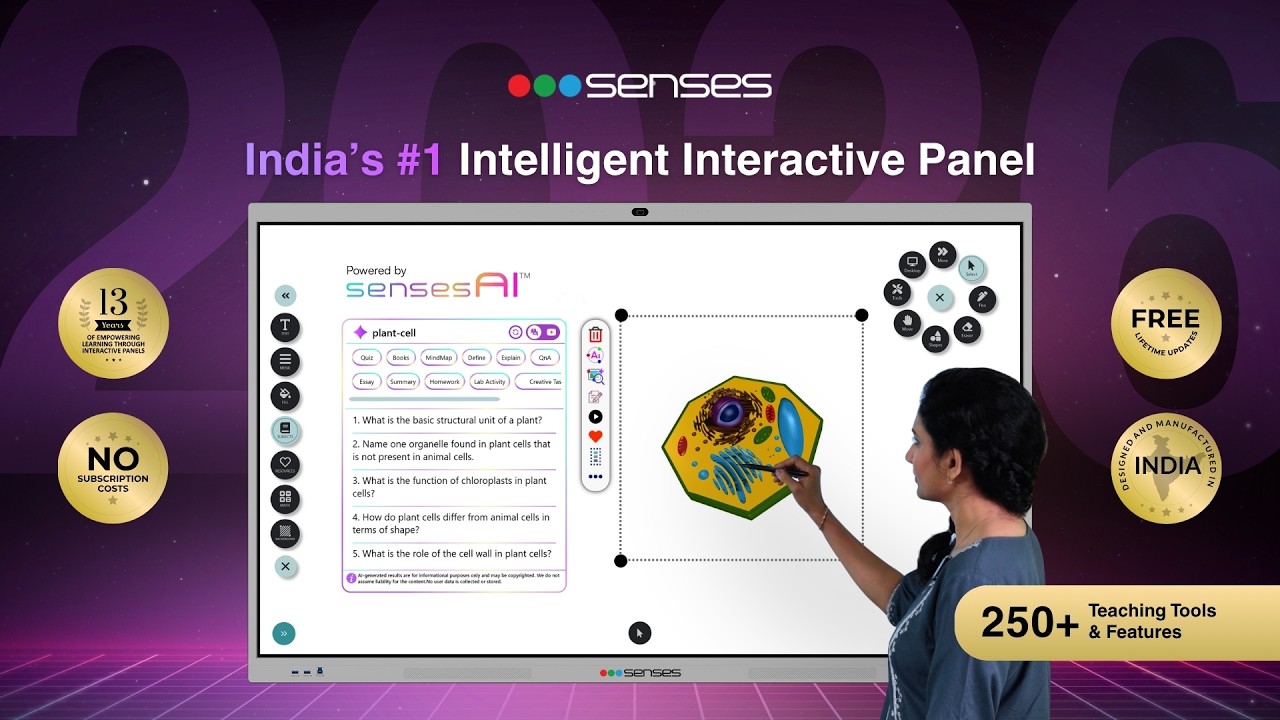
Benefits of Smart Whiteboards for Classrooms
Smart electronic whiteboards deliver value when certain classroom conditions are met.
They are worth the investment when:
- Teachers use the board as part of regular lesson delivery
- Training is provided, so features are actually used in class
- Teaching software supports curriculum-aligned instruction
- Reliable service support is available during the academic year
In these cases, schools often see consistent usage rather than underutilised hardware.
Smart Electronic Whiteboard vs Traditional Projector Setup
| Feature | Smart Electronic Whiteboard | Traditional Projector Setup |
| Writing and Annotation | Teachers can write directly on the screen with touch support | Requires separate whiteboard or external device |
| Visibility | 4K display with better brightness and clarity | Visibility reduces in bright classrooms |
| Touch Interaction | Multi-touch interactive teaching support | No direct touch interaction |
| Classroom Setup | All-in-one solution with built-in software and audio | Requires projector, laptop, speakers, and cables |
| Maintenance | Lower long-term maintenance | Regular lamp replacement and alignment needed |
| Lesson Saving | Lessons can be saved and shared instantly | Limited lesson saving capability |
| Student Engagement | Supports videos, quizzes, annotations, and collaboration | Mostly presentation-based teaching |
| Device Connectivity | Wireless screen sharing across devices | Often depends on HDMI and wired connections |
| Long-Term Usability | Designed for daily classroom teaching | Better suited for basic projection needs |
When a Smart Whiteboard Is Not Worth It
Not every deployment delivers results. In some situations, the investment falls short.
Smart electronic whiteboards may not be worth it when:
- Teachers are not trained or encouraged to use them daily
- The board is treated as a presentation screen only
- Service support depends on third-party vendors with slow response times
- The focus is on features rather than classroom usability
These gaps often lead to boards being used occasionally rather than as a core teaching tool.
Electronic Whiteboard Cost vs Value in 2026
In 2026, the cost discussion has shifted from upfront price to long-term value.
Schools now evaluate:
- Total cost of ownership over multiple academic years
- Software licensing or upgrade costs
- Downtime caused by delayed service or hardware issues
- Ease of scaling across classrooms
A higher initial cost is often justified when the board remains usable, supported, and relevant over time.
Smart Electronic Whiteboards Available in the Indian Market
Indian schools evaluating smart electronic whiteboards today encounter products from global electronics brands, local distributors, and education-focused manufacturers. Marketplaces and resellers commonly offer solutions from brands such as Samsung, LG, ViewSonic, BenQ, and other interactive panel providers.
Alongside these global brands, Senses Electronics has emerged as one of the top smart electronic whiteboard brands for schools and colleges in India by focusing specifically on classroom teaching requirements rather than only display hardware.
While products across the market differ in pricing and specifications, many institutions now distinguish between general-purpose interactive displays and classroom-grade whiteboards designed for daily teaching, teacher usability, AI-powered learning support, and long-term institutional deployment. Senses Electronics positions itself strongly in this category through its AI-powered SenseBoard™ ecosystem, Google EDLA-certified panels, and education-focused software and support infrastructure.
Why Choose Senses Smart Electronic Whiteboard?
Senses smart electronic whiteboards are designed specifically for Indian classrooms, schools, colleges, and coaching institutes. Unlike general-purpose interactive displays, Senses combines AI-powered teaching tools, classroom-focused software, wireless collaboration, and long-term institutional support within one ecosystem. Features such as SenseBoard, SensesAI, Google EDLA-certified panels, NCERT-integrated teaching support, wireless screen sharing, and centralized classroom management help teachers conduct lessons more smoothly and interactively. With lifetime free software updates, PAN-India in-house support, and solutions already used across thousands of institutions, Senses Electronics has become one of the leading smart electronic whiteboard brands for modern smart classrooms in India.
Institutional-Grade Smart Electronic Whiteboards in Practice
Senses Electronics follows a classroom-first approach focused on consistent usage rather than feature-heavy positioning.
SenseEdge for Regular Classrooms
SenseEdge is designed for everyday school classrooms where reliability and ease of use are essential.
- 4K interactive display with anti-glare coating
- Brightness suitable for well-lit classrooms
- Low-latency touch response for natural writing and annotation
- Built for extended daily classroom usage
SensePro for Advanced Classrooms and Institutions
SensePro is built for larger classrooms, senior secondary sections, and higher education environments.
- High-brightness 4K display options for wider visibility
- Faster touch response for continuous interaction
- Enhanced audio and camera systems for large spaces
- Support for larger panel sizes up to 105 inch
Both models integrate with SenseBoard teaching software, which includes 200+ classroom-focused features aligned with Indian curricula and NEP 2020. Structured teacher training and a pan-India in-house service network support long-term classroom use.
Conclusion
In 2026, smart electronic whiteboards are worth the investment for schools that approach adoption thoughtfully. When supported by teacher training, classroom-ready software, and reliable service, these boards become part of everyday teaching rather than occasional technology.
Senses Electronics has positioned itself as a leading smart electronic whiteboard manufacturer in India by focusing on classroom usability, long-term support, and institutional scale. Through SenseEdge, SensePro, and SenseBoard software, structured training, and in-house service coverage across India, Sense Electronics addresses the practical requirements schools face when adopting digital teaching infrastructure.
FAQ
Senses Electronics is one of the leading smart electronic whiteboard brands in India, offering AI-powered teaching tools, Google EDLA-certified panels, SenseBoard™ software, and PAN-India support.
Schools should look for 4K display quality, teaching software, AI-powered tools, wireless collaboration, teacher training, and reliable service support.
AI-powered smart electronic whiteboards help teachers create lessons, generate assessments, summarise content, and improve classroom engagement more efficiently.
They offer better visibility, touch interaction, and lower maintenance, making them more suitable for regular classroom teaching.