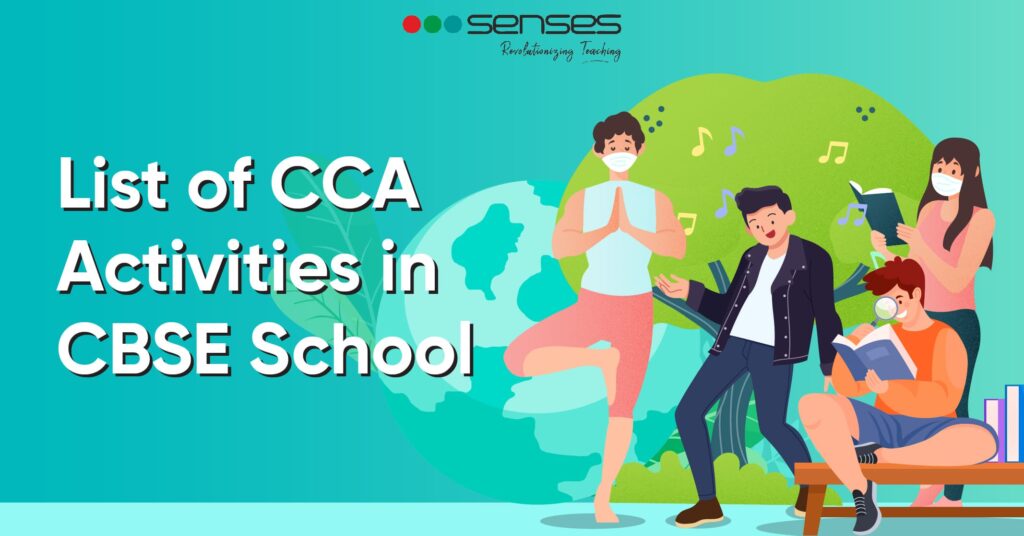
CCA full form in school is Co-Curricular Activities. These are structured activities conducted alongside academics in CBSE schools to improve creativity, leadership, communication, sportsmanship, and overall student development.
In CBSE schools, CCA activities include debates, quizzes, sports, arts, music, science competitions, public speaking, and other skill-based activities that support holistic student growth beyond textbooks. As per CBSE guidelines for 2025-26, schools are encouraged to conduct regular co-curricular activities to help students develop practical, social, and creative skills.
Teachers, school coordinators, and CCA in-charges play an important role in planning and managing these activities throughout the academic year. This guide covers the complete class-wise list of CCA activities for CBSE schools in 2025-26, including KVS activities, competition ideas, examples, and planning tips for schools.
CCA Full Form and Meaning in School
CCA full form in school is Co-Curricular Activities. These are planned, structured activities that complement classroom learning and are an integral part of the CBSE school curriculum. The term ‘CCA’ is widely used across CBSE, KVS (Kendriya Vidyalaya Sangathan), and state board schools across India.
📌 CCA = Co-Curricular Activities. These are school-organised activities that run alongside the academic curriculum to support student development in areas beyond textbooks.
In CBSE schools, CCA activities are not optional — they are a formal part of the school programme designed to:
- Develop cognitive and creative skills in students
- Build confidence, leadership, and teamwork abilities
- Complement and reinforce classroom learning
- Assess students on parameters beyond written examinations
- Prepare students for real-world challenges
CCA Full Form in Education: Co-Curricular Activities — used in school timetables, reports, and CBSE documentation
CCA Subject Full Form: In school timetables, CCA appears as a dedicated period for non-academic activities
Difference Between Co-Curricular and Extracurricular Activities
Most often, Co-curricular and extracurricular activities are used interchangeably. However, there are some differences between them.
Co-curricular activities reinforce the classroom curriculum; however, extracurricular activities refer to activities that occur outside the classroom and don’t supplement the academic curriculum. Extracurricular activities are often not associated with schools.
| Parameter | Co-Curricular Activities (CCA) | Extracurricular Activities |
| Definition | Activities that supplement the classroom curriculum | Activities outside school scope, not linked to curriculum |
| When Conducted | During school hours / CCA period | After school hours or outside school |
| Organised By | School / CBSE officially | Student clubs, external organisations |
| Examples | Debate, Quiz, Spell Bee, Essay Writing | Private music classes, sports clubs, hobby classes |
| Assessment | Part of school evaluation | Not formally assessed by school |
| CBSE Recognition | Yes — officially mandated | Not formally recognised in CBSE records |
Key Takeaway: CCA activities are school-mandated and curriculum-linked. Extracurricular activities are voluntary and school-independent. Both are valuable but serve different purposes in student development.
Complete List of CCA Activities in CBSE School 2026
Here is the most comprehensive list of CCA activities for CBSE schools updated for the 2025-26 academic session. These activities are designed to develop cognitive, creative, physical, and social skills in students across all grade levels.
Literary & Communication Activities
- Debate Competition — develops critical thinking and public speaking
- Essay Writing Competition — builds research, writing, and analytical skills
- Poetry Recitation — improves language proficiency and confidence
- News Paper Reading / News Reading — builds awareness and reading fluency
- Spell Bee Competition — enhances vocabulary and spelling accuracy
- Extempore Speaking — sharpens quick thinking and communication
- Storytelling Competition — fosters creativity and narrative skills
- Slogan Writing — develops concise expression and marketing thinking
- Letter Writing Competition — builds formal communication skills
Science & Mathematics Activities
- Mathematics Olympiad — identifies exceptional talent in mathematics
- Science Olympiad — encourages scientific inquiry and problem-solving
- Science Model Exhibition — hands-on project-based learning
- Brain Games (Sudoku, Puzzle, Maze, Brain Teasers) — improves memory and focus
- Quiz Competition (Subject-wise) — reinforces academic knowledge
- Astronomy Club Activities — promotes curiosity about space and science
3.3 Art, Craft & Creative Activities
- Poster Designing — combines visual creativity with subject knowledge
- Collage Making — develops fine motor skills and artistic expression
- Handicraft Making — paper origami, handmade bags, wall art, Rakhi making
- Rangoli / Diya Decoration — cultural expression and creativity
- Clay Modelling — develops spatial thinking and fine motor skills
- Painting and Drawing Competition — encourages artistic expression
- Magazine Cover Design Competition — combines design and journalism
- Best Out of Waste — promotes creativity and environmental awareness
- Doodle Art Competition — free-form creative expression
Performing Arts Activities
- Dance Competition (Solo/Group) — develops rhythm, expression, and confidence
- Music / Singing Competition — builds musical talent and confidence
- Drama / Skit / Dramatisation — enhances expression, teamwork, and empathy
- Fancy Dress Competition — cultural awareness and self-expression
- Mime/Street Play — teaches storytelling without words
Team & Leadership Activities
- Classroom Decoration — team planning, creativity, and collaboration
- Event Planning Activity — develops organisational and leadership skills
- Team Sports and Games — builds sportsmanship and teamwork
- Volunteering Activities — social responsibility and empathy
- Advertisement Competition — business thinking and creative marketing
- Social Media Campaign Project — digital literacy for senior classes
Educational & Life Skills Activities
- Book Reading Sessions — builds focus, vocabulary, and public speaking
- Education Camp / School Tour — real-world experiential learning
- Cooking Activity — life skills, measurement, and creativity
- First Aid Training — safety skills and responsible citizenship
- Yoga and Meditation Sessions — mental health and physical wellness
- Internship / Community Work (Class XI-XII) — professional readiness
Class-Wise List of CCA Activities for CBSE Schools 2026
CBSE schools must plan CCA activities according to the cognitive level and interests of students at each grade. Here is the complete class-wise breakdown:
| Class Group | Recommended CCA Activities |
| Nursery to LKG | Fancy Dress, Painting/Drawing, Dancing/Singing, Clay Modelling, Handwriting Activity, Dramatisation of Fairy Tales, Rakhi/Paper Crafting, Memorise National Leaders |
| UKG | Fancy Dress, Rakhi Making/Card Making, Dance/Music, Diya Decoration, Doll/Mask/Cap Making, Drawing/Painting, Best Out of Waste, Newspaper Activity |
| Class I – V | Public Speaking, Poetry Recitation, Collage Making, Bookmark Making, Creative Writing, Rakhi Making/Rangoli, Spelling Bee, Volunteering |
| Class VI – VIII | Debate, Poetry Recitation, Collage Making, Bookmark Making, Digital Painting, Cooking, Handicraft, Volunteering, Quiz, Science Model |
| Class IX – X | Essay Writing, Poster Designing, Science Olympiad, Maths Olympiad, Quiz Competition, Skit/Drama, Sports Activities, Leadership Projects |
| Class XI – XII | Magazine Cover Design, News Reading, Poster Designing, Education Camp, Slogan Writing, Debate, Volunteering, Event Planning, Internship, Social Media Campaign |
CCA Activities for KVS Schools 2026
Kendriya Vidyalaya Sangathan (KVS) schools follow a structured CCA calendar that aligns with CBSE guidelines but has some specific additions. KVS schools conduct CCA activities under the following club categories:
- Eco Club — environmental awareness activities, plantation drives, cleanliness campaigns
- Science Club — experiments, science quiz, model making, astronomy activities
- Mathematics Club — Maths Olympiad, puzzles, brain teasers, calculation challenges
- Literary Club — debate, essay writing, poetry recitation, story writing
- Cultural Club — dance, music, drama, folk art, Rangoli
- Sports Club — kabaddi, athletics, yoga, indoor games
- Health & Wellness Club — yoga day, health awareness, first aid
- Heritage Club — field trips, heritage walks, history projects
KVS Note: KVS schools are required to conduct at least one inter-school CCA competition per academic session. Activities must be documented in the school diary and reported to the regional KVS office.
CCA Competition Ideas for School 2026
Planning the right CCA competitions is crucial for student engagement. Here are fresh, innovative CCA competition ideas categorised by type:
Inter-Class Competition Ideas
- Best Classroom Decoration — theme-based (e.g., Save Environment, Space, Indian Culture)
- Subject Quiz Bowl — team-based quiz covering multiple subjects
- Science Innovation Challenge — students present a solution to a real-world problem
- Maths Speed Contest — mental maths under time pressure
- Digital Poster Making — using apps/tools to create awareness posters
Inter-School Competition Ideas
- Interschool Debate Championship — motion-based formal debate
- Science Model Expo — working models judged on innovation and presentation
- Art & Craft Olympiad — painting, sculpture, origami
- Spell Bee Championship — multi-round spelling competition
- Cultural Festival — folk dance, music, drama from different Indian states
New & Innovative Activity Ideas for 2026
- AI Awareness Workshop — introduce students to basic AI concepts (Class IX-XII)
- Coding Competition — block-based coding for junior, Python for senior
- Environment Hackathon — solve a local environmental challenge in teams
- Social Media Awareness Campaign — create responsible digital content
- Financial Literacy Quiz — basics of saving, budgeting for senior students
CCA Period — Meaning and Importance
The CCA period in school refers to a dedicated time slot in the school timetable specifically allocated for co-curricular activities. It is separate from regular academic periods and is used to conduct CCA activities, club meetings, competitions, or skill development sessions.
CCA Period Full Form: Co-Curricular Activity Period
Duration: Typically 40-45 minutes — same as a regular academic period
Frequency: Usually once or twice per week depending on school policy
Purpose: To ensure structured, regular engagement with non-academic skills
CBSE Recommendation: Schools should ensure the CCA period is not used for academic catch-up classes. The time must be genuinely dedicated to co-curricular activities as per school CCA calendar.
Role of Smart Classroom Technology in CCA Activities
Modern CBSE schools are increasingly using smart boards, interactive flat panels, and classroom software to conduct CCA activities more effectively. Schools use interactive classroom technology for quiz competitions, debates, digital presentations, online competitions, art activities, and collaborative learning sessions.
Solutions like SenseBoard, SenseConnect, and AI-powered interactive flat panels help teachers manage co-curricular activities more efficiently while improving student engagement and classroom participation.
How to Balance Academics with Co-Curricular Activities
Balancing academics and CCA is one of the most common challenges for teachers and school coordinators. Here are five practical strategies:
Strategy 1 — Integrate CCA with Lesson Plans
Embed activities like quizzes, debates, and online brain games directly into your lesson plan. A debate on a topic already taught in class becomes both a revision tool and a CCA activity — saving time and doubling impact.
Strategy 2 — Use Smart Classroom Technology
Modern interactive panels Faand smart boards allow teachers to run quizzes, display student work, conduct live polls, and access subject-wise activity templates — all within a single class period. This reduces preparation time and increases CCA quality.
Strategy 3 — Plan a CCA Calendar in Advance
Create a month-wise CCA calendar at the start of the academic year. Assign specific activities to specific months aligned with the academic calendar — for example, conduct science model exhibitions in October and literary competitions in January.
Strategy 4 — Set Clear Priorities
During exam preparation months, choose CCA activities that directly support learning — chapter-wise quizzes, essay writing on exam topics, or Spell Bee on subject vocabulary. During non-exam months, conduct creative and competitive activities.
Strategy 5 — Track and Document CCA Participation
Maintain a CCA record for each student. Use it during parent-teacher meetings to demonstrate holistic growth beyond marks. This motivates students and ensures accountability for CCA participation.
Conclusion
Co-Curricular Activities (CCA) are a non-negotiable part of quality education in CBSE schools. A well-planned CCA calendar for 2025-26 helps students develop confidence, creativity, and leadership — skills that no textbook can teach alone.
For school coordinators and teachers: Use the class-wise list above to plan your annual CCA calendar, integrate activities into your lesson plans wherever possible, and ensure the CCA period is genuinely used for its intended purpose.
FAQs Related to the List of CCA Activities
CCA full form in school is Co-Curricular Activities. These are structured activities conducted alongside the academic curriculum in CBSE and other schools across India to support the holistic development of students.
CCA period in school is a dedicated time slot in the school timetable for co-curricular activities. It is typically 40-45 minutes and held once or twice a week. During this period, students participate in debates, quizzes, art activities, sports, or club meetings.
CCA activities for primary classes (Class I to V) include: Poetry Recitation, Spell Bee, Collage Making, Bookmark Making, Creative Writing, Rakhi Making, Rangoli, Fancy Dress, and Painting/Drawing competitions. These activities are designed to be age-appropriate and fun.
CCA (Co-Curricular Activities) are school-organised activities that supplement the curriculum and are conducted during school hours. Extracurricular activities happen outside school hours and are not linked to the curriculum — such as private music classes or external sports clubs.
Good CCA competition ideas for school include: Inter-class Debate, Science Model Exhibition, Maths Olympiad, Spell Bee Championship, Poster Designing, Classroom Decoration Contest, Digital Awareness Campaign, and Cultural Performance Competitions
In education, CCA stands for Co-Curricular Activities — structured, school-managed activities that run alongside the academic curriculum. They play a key role in developing students’ social, emotional, creative, and physical skills beyond classroom learning.